Unknown's avatar

MET Occipitoatlantal (C0-C1)-ext.

Diagnosis

  • Position:  ESrightRleft
  • Motion Restriction:  Forward-bending, left side-bending, right rotation.

Treatment

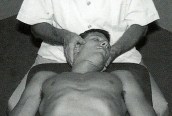
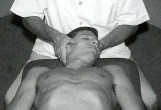
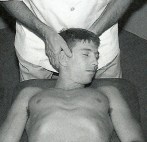
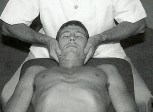
Patient is supine on the table with the operator sitting or standing at the head.

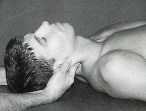
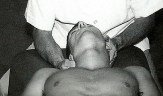
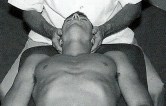
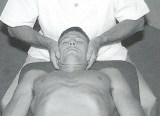
Operator’s left hand controls the patient’s occiput with the web of the thumb and the index finger along the soft tissues of the suboccipital area.OAext2



The operator’s right hand cups the chin with the index finger in front and the middle finger below the tip of the ramus.  The operator’s right forearm is OAext3placed along the right side of the patient’s head.


Forward-bending is introduced by rotating the head forward by the operator’s hands around a transverse axis through the external auditory meatus.OAext4
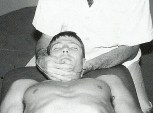


Left side-bending and right rotation are introduced by the operator’s right forearm with slight left-to-right translation of the patient’s head to engage the restrictive barrier. OAext5(Right rotation is not actively introduced)


Patient instruction is to push the head directly posterior toward the table and into the hand offering resistance for 3-5 seconds of a mild isometric contraction. (An eye motion activating force is to look up toward the operator or toward the eyebrows.)

After relaxation, the operator engages the new forward-bending, left side-bending, and right rotational barriers.

Patient repeats the isometric contractions 3-5 times.

Retest.

Unknown's avatar

MET Occipitoatlantal (C0-C1)-flex.

 Diagnosis

  • Position:  FSrightRleft
  • Motion Restriction:  Backward-bending, left side-bending, right rotation.

Treatment

Patient is supine on the table with the operator sitting or standing at the head.

Operator’s left hand controls the patient’s occiput with the web of the thumb and the index finger along the soft tissues at the cervicocranial junction.OAflex2


Operator’s right hand holds the patient’s chin with the index finger in front and the middle finger below the tip of the ramus and with the right forearm in OAflex3contact with the right side of the patients head.


The backward-bending barrier is engaged by the operator’s hands rotating the head posteriorly around a transverse axis through the external auditory meatus.OAflex4


Left side-bending is introduced through the operator’s right forearm by slight left-to-right translation. (Rotation is not actively introduced)OAflex5


The patient is instructed to look down at the feet or pull the chin toward the chest against resistance offered by the operator’s right hand for a 3-5 second light isometric muscle contraction.

After relaxation, the new backward-bending, left side-bending , and right rotational barriers are engaged.

Operator’s muscle contraction is repeated 3-5 times with the operator relocalizing against the resisted barrier after each effort.

Unknown's avatar

MET C2-C3 ERS

Typical Cervical Vertebra (C2-C3)

Diagnosis                 

Position:  Extended, left side-bent, and left rotated (ERSleft).

Motion Restriction:  Forward bending, right rotation, and right side-bending (FRSright).

The C2 left facet won’t open.

Patient is supine on the table with the operator sitting at the head.

Operator’s left hand supports the occiput with the left thumb over the left C2-C3 zygopophysial joint.MET C2-C3 ERS left 2


MET C2-C3 ERS left 3Operator’s right hand is placed on the patient’s right frontoparietal region to control head movement.


Operator’s two hands roll the head and upper neck into forward bending as far as the C2-C3 interspace.MET C2-C3 ERS left 4


Operator introduces right side-bending and right rotation by right-to-left translation through the left index finger contact on the right zygopophysial joint of C2-C3, engaging MET C2-C3 ERS left 5the flexion, right side-bending, and right-rotation restriction.
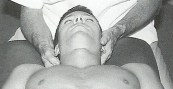


Patient exerts a 3-5 second isometric contraction into backward-bending, left side-bending, or left rotation.  Following relaxation, the operator engages the new flexion, right side-bending, and right rotational barriers.  Repeat 3-5 times.

Unknown's avatar

MET C5-C6 (FRS)

Cervical Spine Muscle Energy Technique

Typical Cervical Vertebra (C5-C6)

Diagnosis

Position:  Flexed, rotated left, and side-bent left (FRSleft)

Motion Restriction:  Extension, right rotation, and right side-bending (ERSright)

The C5 right facet won’t close.

Treatment

Patient is supine on the table with the operator sitting at the head of the table.

Operator’s finger tips of the right index and middle finger are placed on the right articular pillar of C6 to hold the segment so that C5 can be moved upon it.MET C5-C6 ERS left 2


Operator’s left hand controls the left side of the patient’s head and neck.MET C5-C6 ERS left 3


Operator’s right fingers translate the segment anteriorly introducing motion to the backward-bending barrier.MET C5-C6 FRS left 4.jpg


Operator’s left hand introduces right side-bending and rotation of the head and neck to the right by right to left translation engaging the right rotation and the right side-bending barriers.MET C5-C6 FRS left 5


Patient exerts a small isometric effort against the operator’s resisting left hand into forward bending, left side-bending, or left rotation.MET C5-C6 FRS left 6


After a 3-5 second muscular effort, the patient relaxes and the operator increases translatory movement in an anterior and right to left direction engaging the backward-bending, right side-bending, and right rotation barriers.  This process is repeated 3-5 times.

Retest.

Unknown's avatar

Occipitoatlantal (C0-C1) Condylar Glide

Accuracy in assessing condylar glide restriction is dependent on first biasing the condyles, anteriorly or posteriorly, into the direction which is being assessed.

 Patient is supine on the table with the operator sitting at the head of the table.

Operator grasps the sides of the head with each hand and biases the condyles anteriorly by rotating the head posteriorly around an axis through the external auditory meatus while monitoring the first movement of the atlas.OASupCG2
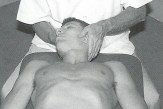


Operator then rotates the head 30˚ to the right.OASupCG3


Operator introduces anterior translatory movement of the head asking the right condyle to glide anteriorly while sensing forOASupCG4
resistance.


Operator then rotates the head 30˚ to the left.OASupCG5


Operator introduces anterior translatory movement of the head asking the left condyle to glide anteriorly while sensing for resistance.OASupCG6


Operator grasps the sides of the head with each hand and biases the condyles posteriorly by rotating the head anteriorly around an axis through the external auditory meatus while OASupCG7monitoring the first movement of the atlas.


Operator then rotates the head 30˚ to the right.OASupCG8


Operator introduces posterior translatory movement of the head asking the right condyle to glide posteriorly while sensing for resistance to movement.OASupCG9


Operator then rotates the head 30˚ to the left.OASupCG10


Operator introduces posterior translatory movement of the head asking the left condyle to glide posteriorly while sensing for resistance to movement.OASupCG11


This tests for the forward-bending and backward-bending capacity of each condyle.  If resistance is encountered, there will be restriction of the side-bending and rotational motion coupled to opposite sides (the minor movements).  Most often, a condyle will resist posterior glide (flexion).  If this were true on the right, C0-C1 would be documented as extended and side-bent right and rotated left (ESleftRright).

Unknown's avatar

Occipitoatlantal (C0-C1) Flexion Restriction

Patient is supine on the table with the operator sitting at the head of the table.

Operator’s hands grasp the sides of the patient’s head with the lateral aspect of the index
fingers monitoring along the posterior arch of the atlas and the rest of each hand controlling the head.

Operator forward bends the patient’s head by anterior rotation around an axis of rotation OASupFR3through the external auditory meatus while monitoring for the first movement of the atlas.


Using the hands, the operator introduces translation from right to left sensing for resistance to movement at his index fingers.  If resistance is felt, the motion restriction is OASupER4to forward bending, right side-bending, and left rotation (ESleftRright).  Something interfered with the left condyle’s ability to glide posteriorly.


Using the hands, the operator introduces translation from left to right sensing for resistance to movement at his index fingers.  If resistance is felt, the OASupFR5motion restriction is to forward bending, left side-bending, and right rotation (ESrightRleft).  Something interfered with the right condyle’s ability to glide posteriorly.

Unknown's avatar

Atlantoaxial (C1-C2)

Patient is supine on the table with the operator sitting or standing at the head of the table.

Operator’s hands hold each side of the patient’s head with the index fingers monitoring the posterior arch of the atlas.  The operator flexes the patient’s head and neck to provideAASup2 restriction of the typical cervical segment rotation through ligamentous locking.  Neck flexion must be maintained throughout the procedure.


Operator’s hands introduce right rotation sensing for resistance to movement at his index fingers.  If resistance is encountered, the motion restriction is to right rotation (atlas is AASup3rotated left).


Operator rotates the head to the left sensing for resistance to movement at his index fingers.  If resistance is encountered the motion restriction is to left rotation (atlas is AASup4rotated right).

Unknown's avatar

Typical Cervical Segments C3-C7: ERS

Extended, Rotated, and Side-bent Dysfunction

Patient is supine on the table with the operator sitting at the head of the table.

Operator’s index and middle fingers of each hand contact the pillar of the superior vertebra of the motion segment being tested.

Operator’s palms and thenar eminences control the patient’s head and upper cervical spine.

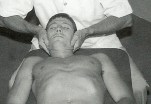
Operator flexes the head and neck down to the segment under examination.  ERS4


With the palm and thenar eminence controlling the patient’s head and upper cervical, the operator introduces translation from right to left, sensing for resistance to movement at ERS5his index fingers.  If resistance is felt, the motion restriction is to forward-bending, right side-bending, and right rotation (indicating that the segment is extended, rotated and side-bent left [ERSleft]).  Something has interfered with the capacity of the left facet to open.
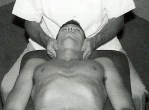
With the palm and thenar eminence controlling the patient’s head and upper cervical, the operator introduces translation from left to right, sensing for resistance to movement atERS6 his index fingers.  If resistance is felt, the motion restriction is to forward-bending, left side-bending, and left rotation (indicating that the segment is extended, rotated, and side-bent right [ERSright]).  Something has interfered with the capacity of the right facet to open.
Unknown's avatar

Typical Cervical Segments C3-C7: FRS

Flexed, Rotated, and Side-bent Dysfunction

Patient is supine on the table with the operator sitting at the head of the table.

Operator’s index and middle fingers of each hand contact the pillar of the superior vertebra of the motion segment being tested. FRS2


Operator’s palms and thenar eminences control the patient’s head and upper cervical spine.  FRS3


Operator backward-bends the head and neck down to the segment under examination. FRS4


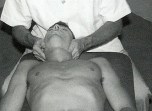
With the palm and thenar eminence controlling the patient’s head and upper cervical, the FRS5operator introduces translation from right to left, sensing for resistance to movement at his index fingers.  If resistance is felt, the motion restriction is to backward-bending, right side-bending, and right rotation (indicating that the segment is flexed, rotated and side-bent left [FRSleft]).  Something has interfered with the capacity of the left facet to close.
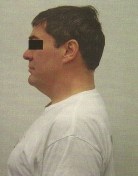
With the palm and thenar eminence controlling the patient’s head and upper cervical, the FRS6operator introduces translation from left to right, sensing for resistance to movement at his index fingers.  If resistance is felt, the motion restriction is to backward-bending, left side-bending, and left rotation (indicating that the segment is flexed, rotated, and side-bent right [FRSright]).  Something has interfered with the capacity of the right facet to close.
Unknown's avatar

Ideal Alignment of the Cervical Region

Ideal alignment of the cervical region allows the head to be positioned with minimal muscular effort.  Ideal alignment is an inward lordotic curve with both the upper and lower cervical region in a position of slight extension.

The most common alignment impairment observed in the cervical spine is a forward head posture.  The forward head posture is characterized by a forward translation of the lower cervical region, and hyperextension of the cervical region with typicaly, an increased kyphotic curve in the thoracic region.

Normal                                             Forward Head

scan0003 - Copy - Copy                        scan0003 - Copy

scan0003                       scan0003 - Copy (2)

The muscular adaptations associated with a forward head position are shortening of the cervical spine extensors and a lengthening of the intrinsic cervical spine flexors.  The forward head position also requires increased activity of the extensor muscles of the cervical spine to counter balance the head against the effect of gravity.  The muscular adaptations that occur with a forward head position results in an increase in compressive forces acting on the articular facets.

Additional alignment faults may include an increase in the degree of upper cervical extension in comparison to that of the lower cervical spine, suggesting possible muscular adaptations in the suboccipital region.  These adaptations can include shortness of the suboccipital extensors, superior obliques, inferior obliques, and rectus capitus and lengthened position of the suboccipital flexors, rectus capitus lateralis and anterior muscles.