
Typical Cervical Vertebra (C2-C3)
Diagnosis
Position: Extended, left side-bent, and left rotated (ERSleft).
Motion Restriction: Forward bending, right rotation, and right side-bending (FRSright).
The C2 left facet won’t open.
Patient is supine on the table with the operator sitting at the head.
Operator’s left hand supports the occiput with the left thumb over the left C2-C3 zygopophysial joint.
 Operator’s right hand is placed on the patient’s right frontoparietal region to control head movement.
Operator’s two hands roll the head and upper neck into forward bending as far as the C2-C3 interspace.
Operator introduces right side-bending and right rotation by right-to-left translation through the left index finger contact on the right zygopophysial joint of C2-C3, engaging  the flexion, right side-bending, and right-rotation restriction.
Patient exerts a 3-5 second isometric contraction into backward-bending, left side-bending, or left rotation. Following relaxation, the operator engages the new flexion, right side-bending, and right rotational barriers. Repeat 3-5 times.
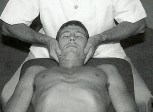
 his index fingers. If resistance is felt, the motion restriction is to forward-bending, right side-bending, and right rotation (indicating that the segment is extended, rotated and side-bent left [ERSleft]). Something has interfered with the capacity of the left facet to open.
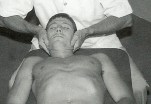 his index fingers. If resistance is felt, the motion restriction is to forward-bending, left side-bending, and left rotation (indicating that the segment is extended, rotated, and side-bent right [ERSright]). Something has interfered with the capacity of the right facet to open.
 castlebodywork