Unknown's avatar

What you can expect…

My practice is, essentially, referral only.  What this means is that people  typically find outCastlebodywork about me through word of mouth; by a physician referral or a referral from a current or past client.  I do not advertise.  I do, however, maintain a combination web page/blog which can be accessed at castlebodywork.com., where you can find out more about me and my  practice.  The first thing I explain to my clients is the difference between ‘structural’ and ‘functional lesions’.  Structural lesions are ‘physical damage’ that can be imaged (MRI), and are typically treated with surgery and/or immobilization. I do not treat structural lesions.  If I suspect, or through evaluation discover that you have a structural lesion, I will be referring you to a specialist. Evaluating and treating functional lesions is my field of expertise.  This is what my practice is based on. 
Specifically, I am engaged in preventing the occurrence, or the recurrence, of pain that is related to functional lesions.

BlueLine1

“Functional lesions, which are the typical cause of chronic pain syndromes, cannot be observed directly with structural tools such as MRI.  Clinicians must be able to envision the dysfunction by understanding the complex interactions of the ‘sensorimotor’ system.” (Vladimir Janda, MD)

Clients suffering from chronic pain are confronted by a unique disorder—a personal experience unlike any other physical malady. While an X-ray can confirm a broken bone and an infection can be detected by a simple blood test, there are no universally reliable tests available to measure pain levels. Because of this, many common musculoskeletal complaints are incorrectly assessed and treated. (Erik Dalton, Ph.D)

My basic assessment consists of:   Client History, Asymmetry Assessment, Postural Evaluation, Active/ Passive/ Resisted Range of Motion Testing, and Tissue Texture Abnormality Assessment.

My advanced assessment consists of Precautionary Tests and assessment of: Dysfunctional Movement (pain), Joint Capsule Restriction, Malalignment Syndromes, and other Orthopedic Assessments.

Treatment techniques include:  Advanced Myoskeletal Alignment Techniques, Orthopedic Massage, Muscle Energy Technique, Proprioceptive Neuromuscular Facilitation (PNF), Trigger Point Therapy, Strain-Counter-Strain, Integrated Neuromuscular Inhibition Technique, Arthrokinetic Technique, Functional Movement, Gait Pattern Training, Fascial Fitness Training, Strength and Conditioning, and more…

“To achieve a noticeable reduction of increased excitability in the neuronal pool, the pain-generating stimulus must be interrupted until the memory burned into the nerve cells has been completely forgotten. For many chronic-pain cases, a serial-type deep-tissue therapy works best when clients are seen twice weekly until hyperexcited receptors feeding the CNS are quieted. This process helps inhibit the chemical activation of pain at the site of its peripheral stimulation and often allows the brain to downgrade the condition and relieve protective spasm.”  (Vladimir Janda, M.D.)

We will be engaged in both bodywork and movement training when we are working together.  You will also be engaged in movement training  at home.  These are the essential elements for treating functional lesions (chronic pain).

“First, put the tissue back where it belongs, then introduce movement.”  (Dr. Ida P. Rolf)

You should know, up front, that this type of therapeutic work is not Relaxation Massage or what is known as ‘passive treatment’.  Chronic pain syndromes cannot be treated passively.  You will be engaged in a combination of ‘active assessment and treatment’ for approximately 90 minutes.  You may even feel a bit of soreness for the next 2 or 3 days.

Most clients begin to feel much better and move painlessly almost immediately. However, some client presentations that include long-term postural, movement, or tissue impairment can take several sessions before showing improvement.  Sometimes ‘putting the tissue back where it belongs’ can release toxins into the body that can have some unpleasant side-effects, at first.

What if you do experience some soreness, bruising, or even swelling?

If any of these symptoms occur, it almost always happens after your first session, and if it does, you need to communicate with your therapist immediately.  If your therapist is new to the field, the mistake of using too much pressure is possible.  With a seasoned practitioner, not so much. A seasoned practitioner should be able to tell you what can cause these symptoms, and how to alleviate them. Typically, these symptoms are greatly reduced and/or disappear completely following subsequent sessions.  If they don’t, a seasoned practitioner will refer you out.

Hydration is one of the key components to be aware of.  Lack of sufficient hydration both before and after a bodywork session can cause or contribute to all of the following symptoms.  If these symptoms are present after a session, continual hydration over the next 3-5 days is imperative.

Muscle Soreness from bodywork is usually a symptom that resembles DOMSDelayed Onset Muscular Soreness is a common response that is often experienced after starting a new exercise, workout, or weight lifting routine.  The day of the first workout you feel great during and after the session.  But, muscle soreness begins to develop within 24 hrs.  This soreness increases to its maximum between 24-48 hrs., and then begins to dissipate and is usually gone in 3-5 days.  Muscle soreness following bodywork, especially if any form of guided contraction or tissue stretching is included, is common, and follows the same pattern as DOMS. Ice, heat, movement, and NSAIDS work great to relieve this symptom.

Minor bruising can also occur, especially on skin where there is less cushioning between the skin and underlying bone, and is not uncommon.  This often appears as a ‘black-and-blue’ discoloration.  One of the goals of the therapy is to increase the circulation.  This brings more heat into the tissue, which helps in the breakdown of the lesions, and also helps in the removal of the waste products created from breaking down adhesive or fibrotic tissue.  The different types of techniques and pressures being utilized by the therapist can result in tiny capillaries being damaged, especially with aggressive bodywork.  The combination of increased blood flow and broken capillaries results in the black-and-blue discoloration.  This type of bruising is also common in other therapeutic techniques such as ‘cupping’ and the ‘Graston Technique’.  Self-massage and heat that increases circulation helps to speed up the healing, but usually time is the main factor, as it will take a few days for the discoloration to disappear.

Myofascial adhesions and fibrotic tissue are usually good indicators of a reduction in blood flow/circulation.  Less blood flow also means less heat.  Since fascia is a colloid substance, it reacts to increases or decreases in heat.  If the heat increases, the fascia (connective tissue) becomes more fluid/solution like and glides normally.  If the circulation is reduced, the myofascia cools and begins to gel-up and get sticky.  This can result in loss of normal gliding, and build up of sticky adhesions between muscles and other structures.  Over time, these sticky adhesions begin to harden and can completely limit the gliding. So, when you find myofascial adhesions and fibrotic tissue that are no longer gliding with each other, you can be pretty sure that the  circulation has been impaired. Impaired circulation can be major contributor to the next symptom; swelling.

Swelling that occurs following a bodywork session is indicative of congestion in the circulatory system, particularly the lymph system.  Manually breaking down a significant amount of fibrotic adhesions can release a tremendous amount of (sometimes ‘toxic’) waste products into the circulatory system.  The circulatory system can often be compromised by fibrotic scar tissue,’gelled up’ myofascial adhesions, or compressive myofascial wrapping of structures (muscles) containing circulatory vessels.  If the circulatory system is compromised, it can easily be overloaded during the release of adhesive lesions, resulting in swelling.  Even normal circulatory mechanics can be compromised by a significant release of waste products.  This is not an injury, but a temporary response to overloading the circulatory system.  Heat, to increase circulation, and light massage, particularly lymphatic drainage techniques, will speed the process of reducing any swelling that might occur.

The intent behind Myoskeletal Alignment or Orthopedic Massage is never to cause discomfort or injury, but breaking down adhesions and fibrotic tissue (especially if they have been present for a significant amount of time), working close to the bone, and stretching tissue that hasn’t been stretched before, can often result in any or all of these symptoms.

scan0011“The manual therapy industry has evolved to a place where specializing in just one discipline/modality is no longer sufficient to treat complicated pain conditions and sports injuries. An ‘umbrella’ term, Integrated Manual Therapy, connotes the synergy of many modalities and disciplines integrated together, that allows the therapist to treat each client in a truly individualized manner.” (Waslaski, 2012)

BlueLine2

Unknown's avatar

Fascial Fitness

Fascial Fitness Training Routine from TheCastleMethod

Fascial Fitness BOSU Routine from TheCastleMethod

Introduction

With chronic pain and many forms of overuse injuries, the problem is often not found in the musculature or skeleton.  Most of the time it can be found in the connective tissue—ligaments, tendons, joint capsules, and so on—that have been loaded beyond their present capacity.

Focused training of the fascial network for athletes and other movement advocates could be of great value especially if one is experiencing chronic pain due to a functional lesion (no apparent physical damage).

If one’s fascial body is well-trained—optimally elastic and resilient—then it can be relied on to perform functionally, effectively, and in a pain-free manner.

Until recently, sports trainers, coaches, athletes, and other active groups have primarily focused on the classical triad of muscular strength, cardiovascular conditioning, and neuromuscular coordination.  Some alternative physical training activities such as Pilates and yoga have taken the connective tissue network into account in a general sense, but without modern insights from the field of fascial research.

In order to build or restore an injury-resistant and elastic fascial body network, that will provide a pain-free movement experience, it is essential to translate the current insights from the field of fascial research into practical training techniques and regimens.

Fascial Remodeling

One of the most impressive characteristics of connective tissue is its ability to adapt.  When placed under regular increasing physiological strain, it alters its architectural properties to meet the increasing demand (sounds a lot like the ‘Overload Principle’).  Fascial tissues react to dominant loading patterns.  The varied capacities of fibrous collagenous connective tissue make it possible for these tissues to continually adapt to regularly occurring strain, especially in relation to changes in length, strength, and ability to shear.

With the help of fibroblasts, fascial tissues react to everyday strain as well as to specific training by steadily remodeling the arrangement of their collagenous fiber network.  Approximately 50% of the collagen fibrils are replaced in a healthy body every year.  The intention of fascial fitness is to influence this replacement through specific training activities that will, after 6-24 months, result in a silk-like bodysuit, which is not only strong, but also allows for smoothly gliding joint mobility over wide angular ranges.

Elastic Recoil of Fascial Tissues:  The Catapult Mechanism

The science tells us that kangaroos can jump much further than the force of the contraction of their leg muscles should allow.  Scientists have discovered that a spring-like mechanism is behind this unique ability—the so-called ‘catapult mechanism’.  The tendons and muscles of the leg are tensioned like elastic bands.  The release of this stored energy is what makes these amazing jumps possible.

High-resolution ultrasound examination made it possible to discover similar orchestration of loading between muscle and fascia in human movement.  It has been discovered that the fascia of humans has a kinetic storage capacity similar to that of kangaroos.

This stored energy is not only used when we jump or run, but also with simple walking, as a significant part of the energy for the movement pattern of walking comes from the same catapult mechanism described above.  This new discovery has led to an active revision of the long-accepted principles in the field of movement science.

In the past, scientists assumed that joints moved when the skeletal muscles surrounding the joint shortened and the energy from the muscles passed through the passive tendons to create movement.  This classical form of energy transfer is still true for cyclical movement patterns such as bicycling.  During these types of steady movements, the muscle fibers actively change in length, while the aponueroses and tendons do not change their length very much while they are loaded.  The fascial elements remain quite passive.

Oscillatory movements, such as jogging, however, display an elastic spring quality in which the length of the muscle fibers changes little.  During oscillatory movements, the muscle fibers contract in an almost isometric fashion—they stiffen temporarily without any significant change in length—while the fascial elements function in an elastic manner.  In this way, the lengthening and shortening of the fascial elements is responsible for the actual movement.

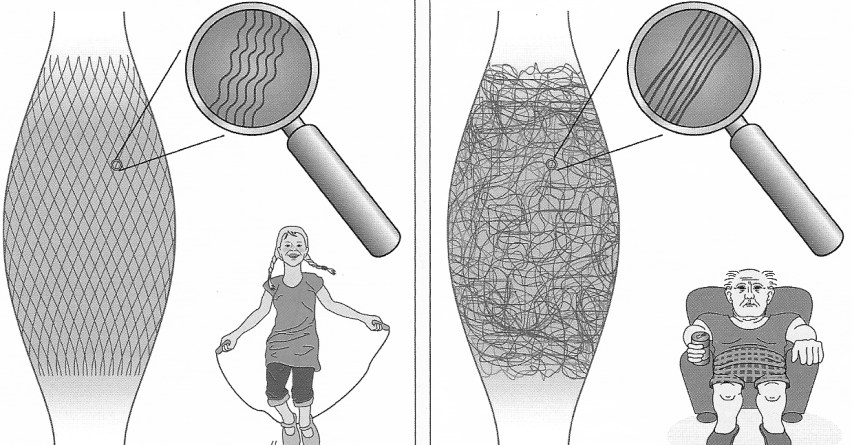
The elastic movement quality in younger people is associated with a typical two-directional lattice arrangement of their fasciae.  In contrast, as we age and typically lose the springiness in our gait, the fascial architecture takes on a more haphazard and multidirectional arrangement.

scan0013 - Copy

Experiments have shown that lack of movement quickly fosters the development of additional cross-links in fascial tissues.  The fibers lose their elasticity and do not glide as they once did.  Instead theybecome stuck together and form tissue adhesions.  In the worst cases, they become matted together.

Collagen architecture responds to loading.  Fasciae of younger individuals (left image above) typically expresses a two-directional lattice orientation of their collagen fiber network.  The individual collagen fibers show a stronger ‘crimp’ formation.  Application of appropriate exercise can induce altered collagen architecture with increased crimp formation.  Lack of proper exercise (right image above) has been shown to induce a multidirectional fiber network and decreased crimp formation.

The goal of fascial fitness training is to stimulate fascial fibroblasts to lay down a more youthful fiber architecture.  This is done through movements that load the fascial tissues over multiple extension ranges while utilizing their elastic springiness.

A dynamic muscular loading pattern, in which the muscle is both activated and extended, promises a more comprehensive stimulation of fascial tissues than either classical weight training or Hatha yoga stretches.

Training Principles

1.       Preparatory Countermovement

To achieve preparatory counter-movement one makes use of the catapult effect, previously described.  Before performing the actual movement, the individual begins by creating a slight pre-tensioning in the opposite direction.  Pre-tensioning is comparable to using a bow to shoot an arrow.

2.       The Ninja Principle

To practice this principle, when performing bouncing movements such as hopping, running, and dancing, one must execute each movement as smoothly and softly as possible.  One should gradually decelerate before any change in direction and gradually accelerate afterward.  Each movement should flow from the last, and any extraneous or jerky movements should be avoided.  The more the fascial spring effect is utilized, the quieter and gentler the movement will be.

3.       Dynamic Stretching

Dynamic stretching requires a more flowing stretch, rather than a stretch that holds a motionless, static position.  Fascial fitness training utilizes both fast and slow dynamic stretching.  The faster variation may be more familiar to many people, as it has been a part of past physical training techniques.  You may remember it as ‘ballistic stretching’.  For decades it has been considered as being generally harmful to the tissue, but recent research has confirmed the method’s potential merits.

It’s probably not a great idea to start this type of dynamic stretching without first warming up a bit, but it seems that long-term and regular use of fast dynamic stretching—if performed properly— can positively influence the architecture of the connective tissue, as connective tissue becomes more elastic when this type of exercise is performed correctly.  The ninja principle should be observed during fast dynamic stretching, and fast dynamic stretching has even greater effect on the fascia when combined with a preparatory counter-movement, as previously described.

In contrast to the bouncing motion of fast dynamic stretching, slow dynamic stretching engages multi-directional movements, with slight changes in angle.  This engagement is not done by passively waiting, as in a lengthening classical Hatha yoga pose, or in a conventional isolated muscle stretch.  Instead, these movements include motions in all three planes of motion (sagittal, frontal, and transverse), including anterior, posterior, lateral, and spiral movement patterns.

Slow dynamic stretches involve large areas of the fascial network being stretched simultaneously.  Instead of stretching isolated muscle groups, slow dynamic stretching targets movement patterns that engage the longest possible myofascial chains.

4.       Proprioceptive Refinement

Proprioception can be defined as the ability to sense where one’s body parts are located in relation to each other.  Because proprioception is necessary for movement control, it must be included in the practice of fascial fitness.  To more finely attune one’s proprioceptive capabilities, knowledge of the location of proprioceptive nerve endings is necessary.

It is of interest to note that the classical joint receptors—located in joint capsules and associated ligaments—have been shown to be of less importance for normal proprioception, because typically they are stimulated only at extreme joint ranges, but not during physiological motions.  Recent findings indicate that the superficial fascial layers of the body are, in fact, far more densely populated with mechanoreceptive nerve endings than tissue situated more internally.  It follows that, proprioceptive nerve endings located in the more superficial layers are a better target for exercises, as in these areas, even small angular joint movements lead to relatively distinct shearing motions.  Therefore, perceptual refinement efforts should focus on producing shear, gliding, and tensioning motions in superficial fascial motions.

It is important to remember that when movements become too repetitive, our body ceases to maintain its proprioceptive awareness and our sense of proprioception cannot be properly engaged.  To prevent ‘sensory dampening’ we need to keep our exercises both varied and creative.

In addition to the slow and fast dynamic stretches and utilizing elastic recoil properties, fascial refinement activities should include experimenting with various qualities of movement.  For example, extremely slow movements, very quick micro-movements, or large macro-movements involving the whole body.  Also, placing the body in unfamiliar positions while working with the awareness of gravity will quickly and dramatically change the quality of movement in your efforts to refine proprioceptive awareness.

5.       Hydration and Renewal

An in-depth understanding of the plasticity and changing elasticity of the ‘water-filled’ fascia is particularly useful in developing and perfecting our systems of slow dynamic stretching and fascial refinement work.

Approximately 2/3 of the volume of fascial tissues is made up of water.  During application of mechanical load (stretching or local compression) a significant amount of water is pushed out of the more stressed zones, similar to squeezing a sponge.  With the release that follows, this area is again filled with new fluid which comes from the surrounding tissue as well as the local vascular network.  The sponge-like connective tissue can lack adequate hydration at neglected places.  Application of external loading to fascial tissues can result in a refreshed hydration at such places in the body.

In healthy fascia, a large percentage of the extracellular water is in a state of ‘bound’ water (as opposed to bulk water) where its behavior can be characterized as that of a liquid crystal.  Much pathology, such as inflammation, edema, or the increased accumulation of free radicals and other waste products, tends to accompany a shift towards a higher percentage of bulk water within the ground substance.

Recent findings suggest that when local connective tissue gets squeezed like a sponge and subsequently rehydrated, some of the previous bulk water zones may then be replaced by bound water molecules, which could lead to a more healthy water constitution within the ground substance.

The goal of exercise is to refresh such places in the body with improved hydration through specific stretching to encourage fluid movement.  Proper timing of the duration of individual loading and release phases is very important to hydration.  As a part of modern running training, experts often recommend frequent interruption of running with short walking intervals.  There is good reason for this: Under strain, the fluid is pressed out of the fascial tissues, which begin to function less optimally as their elastic and springy resilience slowly decreases.  The short walking breaks serve to rehydrate the tissue, as it is given a chance to take up nourishing fluid.  For average beginning runners, experts recommend walking pauses of one to three minutes every ten minutes.  More advanced runners, with greater body awareness, can adjust the optimal timing and duration of those breaks based on the presence, or lack, of that youthful and dynamic rebound.  If the running movement begins to feel and look more dampened and less springy, it’s probably a good time for a short break.  If after a brief walking break there is a noticeable return of the gazelle-like rebound, then the rest period was adequate.

This cyclic training with periods of more intense effort interspersed with purposeful breaks, is recommended for all facets of fascial training.  The individual learns to the dynamic properties of his or her fascial ‘bodysuit’ while exercising and to adjust the exercises based on this new body awareness.  Fascia-oriented training may also help prevent overuse injuries in connective tissue.

6.       Sustainability: The Power of a Thousand Tiny Steps

An important concept in fascial-oriented training is that of the slow and long-term renewal of the fascial network.  In contrast to muscular strength training—in which big gains occur early on, followed by a plateau with only very small gains—fascia changes slowly and the results are lasting.  Improvements have a lasting cumulative effect, which after years can be expected to result in marked improvements in the strength and elasticity of the global fascial net.  As fascial proprioception becomes refined, the individual will probably experience improved coordination.

It is consistent and regular training that pays off.  Just a few minutes of appropriate exercises performed twice a week is sufficient for collagen remodeling.  The related renewal process takes between six months and two years, and will yield a lithe, flexible, and resilient collagenous matrix.

Of course, fascial fitness should not replace muscular strength work, cardiovascular endurance, or neuromuscular coordination (skill) training.  It should be viewed as an important addition to a comprehensive training program.

This article is adapted from Fascia: The Tensional Network of the Human Body (Elsevier Science, 2012).


Unknown's avatar

Resource Library

  1. Biel, A.  2001.  Trail Guide to the Body.  Boulder:  Books of Discovery.
  2. Bompa, T., Haff G. 2009.  Periodization: Theory and Methodology of Training. Champaign: Human Kinetics.
  3. Bompa, T., Carrera, M. 2005. Periodization Training for Sports. Champaign: Human Kinetics.
  4. Boyle, M.  2010.  Advances in Functional Training.  Aptos:   On Target Publications.
  5. Burger, B. 1998.  Esoteric Anatomy:  The Body as Consciousness.  Berkley:  North Atlantic Books.
  6. Cantu, R., Grodin, A., and Stanborough, R. 2012  Myofascial Manipulation: Theory and Clinical Application.  Austin: PRO-ED, Inc.
  7. Carey, A.   2005.  The Pain-Free Program.  Hoboken:  John Wiley and Sons, Inc.
  8. Chaitow, L.  1997.   Modern Neuromuscular Techniques.  New York: Churchill Livingstone.
  9. Chaitow, L.  1998.   Positional Release Techniques.  London:  Harcourt Brace and Company Limited.
  10. Chaitow, L.  2006.  Muscle Energy Techniques.   Churchill Livingstone Elsevier.
  11. Cook, G.  2003.  Athletic Body in Balance: Optimal Movement Skills and Conditioning for Performance.  Champaign:  Human Kinetics.
  12. Cook, G.  2010.  Movement:  Functional Movement  Systems.  Santa Cruz:  On Target Publications.
  13. Dalton, E., 2014. Myoskeletal Alignment Techniques:  Posture, Pain, Performance. Freedom From Pain Institute.
  14. Dalton, E., 2010. Advanced Myoskeletal Techniques. Freedom From Pain Institute.
  15. Dalton, E., 2012. Dynamic Body: Exploring Form, Expanding Function. Freedom From Pain Institute.
  16. Dalton, E., 2005. Advanced Myoskeletal Alignment Techniques: Head and Neck, Vol. 1. Freedom From Pain Institute (DVD).
  17. Dalton, E., 2005. Advanced Myoskeletal Alignment Techniques: Head and Neck, Vol. 2. Freedom From Pain Institute (DVD).
  18. Dalton, E., 2005. Advanced Myoskeletal Alignment Techniques: Shoulder, Arm, and Hand, Vol. 1. Freedom From Pain Institute (DVD).
  19. Dalton, E., 2005. Advanced Myoskeletal Alignment Techniques: Shoulder, Arm, and Hand, Vol. 2. Freedom From Pain Institute (DVD).
  20. Dalton, E., 2005. Advanced Myoskeletal Alignment Techniques: Shoulder, Arm, and Hand, Vol. 3. Freedom From Pain Institute (DVD).
  21. Dalton, E., 2012. Dynamic Body: Myoskeletal Alignment for Low Back, Hip, and Leg Pain (Myoskeletal Mechanic, DVD).
  22. Dalton, E., 2012. Dynamic Body: Myoskeletal Alignment for Low Back, Hip, and Leg Pain, (Fixing Kinetic Kinks, DVD).
  23. Dalton, E., 2012. Dynamic Body: Myoskeletal Alignment for Low Back, Hip, and Leg Pain, (Bone and Belly Work, DVD).
  24. Dalton, E., 2012. Dynamic Body: Myoskeletal Alignment for Low Back, Hip, and Leg Pain, (Sacroiliac Syndromes, DVD).
  25. Dalton, E., 2012. Dynamic Body: Myoskeletal Alignment for Low Back, Hip, and Leg Pain, (Toning the Core and Pelvic Floor, DVD).
  26. Dalton, E., 2012. Dynamic Body: Myoskeletal Alignment for Low Back, Hip, and Leg Pain, (Unlocking Lumbars, DVD).
  27. Davies, C.  2004.  The Trigger Point Therapy Workbook.  Oakland:  New Harbinger Publications, Inc.
  28. Davies, C.  2006.  The Frozen Shoulder Workbook.  Oakland:  New Harbinger Publications, Inc.
  29. DeStefano L.  2011.  Greenman’s Principles of Manual Medicine.  New York: Lippincott, Williams, and Wilkins.
  30. Digiovanna, E., Schiowitz, S., Dowling, D.  2005.  An Osteopathic Approach to Diagnosis and Treatment.  Philadelphia: Lippincott Williams and Wilkins.
  31. Friel, J., Vance, J.  2013. Triathlon Science. Champaign: Human Kinetics.
  32. Hungerford, M.  1993.  Beyond Sports Medicine.  Sports Massage Training Institute.
  33. Jones, L.  1995.  Strain-CounterStrain.  Boise:  Jones Strain-CounterStrain, Inc.
  34. Juhan, D.  1998.  Job’s Body.  Barrytown:  Barrytown, LTD.
  35. Lee, D.  2004.  The Pelvic  Girdle.  Churchill Livingstone Elsevier.
  36. Lowe, W.  1997.   Functional Assessment in Massage Therapy.  Bend:  Orthopedic  Massage Education and Research Institute.
  37. Magee, D.  2002.  Orthopedic Physical Assessment.  Saunders Elsevier.
  38. Maitland, J. 2001.  Spinal Manipulation Made Simple.  Berkley:  North Atlantic Books.
  39. Mattes, A.  2000.  Active Isolated Stretching.  Sarasota:  Aaron L. Mattes.
  40. Meyers, T.  2001.  Anatomy Trains.  Churchill Livingstone Elsevier.
  41. Page, P., Frank, C., Lardner, R.  2010.   Assessment and Treatment of Muscle Imbalance (The Janda Approach). Champaign: Human Kinetics.
  42. Rattray, R., Ludwig, L.  2000.  Clinical Massage Therapy. Toronto: Talus Inc.
  43. Rolf, I., 1989.  Rolfing: Reestablishing the Natural Alignment and Structural Integration of the Human Body for Vitality and Well-Being. Rochester: Healing Arts Press.
  44. Sahrmann, S.  2002.  Diagnosis and Treatment of Movement Impairment Syndromes.  St. Louis:  Mosby, Inc.
  45. Sahrmann, S., and Associates.  2011.  Movement  System Impairment Syndromes of the Extremities, Cervical, and Thoracic Spines.  St. Louis:  Mosby, Inc.
  46. Salvo, S.  2003.  Massage Therapy:  Principles and Practice.  St. Louis: Saunders Elsevier.
  47. Schamberger, W.  2002.  The Malalignment  Syndrome.  Churchill  Livingstone Elsevier.
  48. Schleip, R., Findley, T., Chaitow, L. Huijing, P. 2012.  Fascia, The Tensional Network of the Human Body
  49. Schultz, R., Feitis, R.  1996. The Endless Web.  Berkley:  North Atlantic Books.
  50. Sills, F.  2001.  Craniosacral Biodynamics (Volume 1).  Berkley:  North Atlantic Books.
  51. Sills, F.  2002.  The Polarity Process.  Berkley:  North Atlantic Books.
  52. Sills, F.  2004.  Craniosacral Biodynamics (Volume 2).  Berkley:  North Atlantic Books.
  53. Smith, J.  2005.  Structural Bodywork. Churchill Livingstone Elsevier.
  54. Stone, R.  1986.  Polarity Therapy:  Volume 1.  Summertown:  CRCS Wellness Books.
  55. Stone, R.  1986.  Polarity Therapy:  Volume 2.  Summertown:  CRCS Wellness Books.
  56. Tappan, F., Benjamin, P.  1998.  Healing Massage Techniques.  Stamford:  Appleton & Lange.
  57. Waslaski, J., 2012.  Clinical Massage Therapy.  Upper Saddle River: Pearson.
  58. Waslaski, J., 2012.  Integrated Manual Therapy and Orthopedic Massage for Complicated Shoulder Conditions (DVD).
  59. Waslaski, J., 2012.  Integrated Manual Therapy and Orthopedic Massage for Complicated Elbow, Forearm, Wrist, and Hand Conditions (DVD).
  60. Waslaski, J., 2012.  Integrated Manual Therapy and Orthopedic Massage for Complicated Knee Conditions (DVD).
  61. Waslaski, J., 2012.  Integrated Manual Therapy and Orthopedic Massage for Complicated Lower Extremity Conditions (DVD).
  62. Waslaski, J., 2012.  Integrated Manual Therapy and Orthopedic Massage for Complicated Shoulder Conditions (DVD).
  63. Waslaski, J., 2012.  Integrated Manual Therapy and Orthopedic Massage for Low Back Pain, Hip Pain, and Sciatica (DVD).
Unknown's avatar

Hiatus

Professional…  1998 – 2002

“Experienced consultant / business analyst / software application developer / project manager.  Exceptional analysis, problem framing, solution synthesis, evaluation, and communication skills.  Strong RDBMS background.  Extensive experience in the fields of infrastructure development, change-management process, clinical research, data analysis, decision support, education, healthcare, human resources, manufacturing, marketing/sales, operations, and public school technology planning. Highly skilled in coaching, teaching, and mentoring.”

Consultant – to the Syracuse City School District (3/01-3/02)

  •  Interfaced with Verizon, VPN Systems, Syracuse Utilities, Simcona Electronics Corp., Telergy, Matrix Communications, Graybar Electric Co. Inc., Cable Express, Cisco, Annese and Associates, Anixter Inc.
  •  Performed Telecommunications Audit for Syracuse City School District.
  •  Project Manager for Elmcrest School Technology Infrastructure project.
  •  Project Manager for Fowler High School Technology Infrastructure project.
  •  Performed and summarized Operational Audit of Syracuse City School District Technology Plan(1997-2001).
  • Created the SCSD Technology Plan Planning Guide 2001.
  • Directed and summarized results of the SCSD Technology Planning Committee Meeting(s).
  • Performed and documented SCSD infrastructure inventories.
  • Developed SCSD infrastructure and wiring schematics.
  • Developed models for leadership, committees, vision, objectives, benefits, needs assessment, inventories, requirements, training, support, operations, policy, action plans, funding, and evaluation.
  • Developed SCSD technology plan objectives, action plan task timelines, cost models for infrastructure/wiring, equipment, software, connectivity, professional development, support, and maintenance.
  •  Developed SCSD action plan task timelines.
  •  Developed SCSD cost models for infrastructure/wiring, equipment, software,        connectivity, professional development, support, and maintenance.
  •  Projected SCSD Technology Plan expenditures.
  •  Secured SCSD E-rate funding for 2001-2006.
  •  Created SCSD Technology Plan 2001-2006 (draft).
  •  Created Apple Airport (wireless) summary document.

Business Analyst / Software Developer   (2/99-3/01)

  • Interfaced with SMEs, end users, and application owners for all project phases.
  • Performed business analyses.
  • Analyzed project requirements.
  • Developed project estimates.
  • Developed application functional specifications.
  • Developed database prototypes and final applications.
  • Tested, maintained, and updated applications.
  • Developed mgmt. info. (decision support) report modules.
  • Performed data validation (existing client data).
  • Wrote documentation for all projects.
  • Trained end users.

Created the following MS ACCESS 8.0 Network Applications, with ACCESS security modules for Arcom Labs, Syracuse, NY.

  • PT2000 Production Tracking and Scheduling Database
  • PT2000 Archive Database
  • PT2000 Sales Database
  • Production Tracking and Reporting Database
  • WIP Queue Production Database
  • WIP Queue Archive Database
  • Modified Finished Goods Inventory Database
  • Engineering Samples Request Database
  • Physical Inventory Database
  • Shipping Database
  • Engineering Release Specifications Database
  • Check Log Database
  • UPS Shipping Database
  • Manning Model Database

Created the following MS ACCESS 8.0 Application, for The Four Winds Society in Palisades, CA.

  • Four Winds Society Event Scheduling, Registration, and Invoicing Database

Senior Consultant/Project Manager/Software Developer,  Keane Inc.   (9/98-2/99)

  • Analyzed project (requirements).
  • Estimated project costs.
  • Scheduled project resources.
  • Created project plans.
  • Assessed project risks.
  • Developed risk mitigation strategies.
  • Wrote Statements of Work.
  • Analyzed/Validated project estimates.
  • Created UTC Carrier Replacement Component Division’s Market Fund Database (MS ACCESS 8.0, Network Application).

Consultant, Analyst, Software Developer, TMD Consulting & Technology, LLC (2/97-9/98)

TMD Software Division

  • Acted as client interface for all project phases.
  • Performed project analyses.
  • Wrote application functional specifications.
  • Developed database applications.
  • Developed mgmt. info. (decision support) report modules.
  • Performed data validation (existing client data).
  • Developed application training courses and materials.
  • Performed client training (client site).
  • Coordinated MIS and DB Administration (client site).
  • Performed local and network installations (client site).
  • Provided software consulting (analysis/programming/development) services.

Responsible for the following projects:

  • Created MobilNet Management Services, Inc.’s Job Tracking and Invoicing Database, (MS ACCESS 8.0, Stand Alone Application).
  • Created “EmpowerTrak,” UTC Carrier  Technical Training’s Employee Training and Development Tracking Database (MS ACCESS 2.0, Network Application).
  • Created “EmpowerTrak Reports,” UTC Carrier Human Resources EmpowerTrak Reports Module (MS ACCESS 2.0, Network Application).
  • Created UTC Carrier Model Machine Shop’s Employee Time, Project Labor Cost, and Client Billing Database (MS ACCESS 7.0, Network Application).
  • Created UTC Carrier Screw Compressor Assembly Department’s Production Line Documentation and Archive Database (MS ACCESS 7.0, Network Application).
  • Performed ongoing consulting services for Bristol Meyers Squib’s Plant Process Materials Tracking Database (MS ACCESS 2.0, Network Application).
  • Performed consulting services for Advanced Data Research, Inc.’s (MS ACCESS 2.0, Network Application).
  • Performed consulting services for Genesee Office Systems, Inc.’s Contractor Job Costing Database (MS ACCESS 8.0)
  • Performed consulting services for Central Locating Services, Inc.’s National Damages Tracking Database (MS ACCESS 2.0, Network Application).
  • Created Syracuse University’s Program Development Reunion Database (MS ACCESS 7.0, Network Application).
  • Created Syracuse University’s Program Development Reunion Database Reports Module (MS ACCESS 7.0, Network Application).
  • Created Welch Allyn, Inc.’s Product Pricing and Distributor Mailing Database (MS ACCESS 7.0, Network Application).
  • Created Utica Boiler Companies’ Installers Database, Wholesalers Database, (MS ACCESS 7.0, Network Applications).


Unknown's avatar

RESUME

           John M. Castle, Ph.D.          

EDUCATION

  • Ph.D., School of Education, Division of Teaching and Curriculum, Department of Physical Education (Exercise Physiology, Sports Psychology), Syracuse University.  1993
  • M.S., School of Education, Division of Teaching and Curriculum, Department of Physical Education (Exercise Physiology) Syracuse University. (no exams taken)   1978
  • B.S., School of Education, Division of Teaching and Curriculum, Department of Physical Education, Syracuse University.  1974

Additional

  • Cert., Myoskeletal Alignment Therapist. 2014
  • Cert., Integrated Manual Therapy & Orthopedic Massage. 2013
  • F.M.S., Functional Movement Systems. 2012
  • L.M.T., Onondaga School of Therapeutic Massage. 2004
  • A.P.P., Ohio Institute of Energetic Studies & Bodywork.  1999
  • A.A.S., Computer Programming/Accounting, Bryant & Stratton Business Institute.  1982

PROFESSIONAL

Private PracticeCastleBodyWork,  Syracuse, NY (2008 – present)

  • Current Projects:
    • Developed and utilized Active Range of Motion Routines to support Integrated Manual Therapy and Myoskeletal Alignment Therapy Bodywork
    • Developed and utilized Gait Pattern ‘Analysis and Neuromuscular Re-Education’ to evaluate, prevent, and treat Idiopathic Lower Back and Hip Pain.
    • Developed and utilized Fascial (connective tissue) Restoration Techniques to stimulate ‘crimped’ collagen fiber replacement (as opposed to ‘flattened’ collagen fiber replacement) with adults and athletes over 30 yrs. of age.
  • Shifted manual therapeutic focus to Structural and Functional Bodywork with emphasis on Integrated Manual Therapy, Myoskeletal Alignment Therapy, and Functional Movement Therapy.  Major focus on pattern recognition, functional evaluation, assessment, and specific treatment protocols for chronic pain syndromes and postural, work, and athletic overuse injuries.
  • Shifted fitness concentration to Periodized Strength Training for endurance athletes and Short-arc Pretension-contraction protocols for restoring connective tissue.

Private Practice, Body, Mind, and Spirit, Fayetteville, NY       (2002 – 2008)

  • Created and developed a successful private Complementary, Alternative, and Preventive Medicine (CAPM) Practice in Fayetteville, NY.
  • Developed and practiced a ‘new model’ for Personal Training and Exercise/Fitness Education termed Collaborative Personal Training (CPT).  CPT is based on a combination of Guided Experience and Education, utilizing methodologies that cannot be performed by the individual alone and achieving results that cannot be realized by the individual alone.  Some of these methodologies include techniques such as Integrated Movement Training, Simultaneous Concentric/Eccentric Manual Loading, Collaborative PNF/ME Stretching, and Anaerobic Threshold Interval Training for maximizing excess post-exercise oxygen consumption (EPOC).
  • Developed and practiced a ‘new model’ for Complementary and Alternative Medicine termed Complementary, Alternative, and Preventive Medicine (CAPM).  This CAPM Practice is based on the integration of Bodywork that includes: Swedish, Orthopedic, and Sports Massage, and Trigger Point/Active Release Therapy.  Energy Medicine that includes: Shiatsu, Polarity Therapy, and Reiki. Autogenic Training that includes: Breathing Techniques, Progressive Muscle Relaxation Techniques, and Kinesthetic and Guided Visualization.  The preventive component is achieved through the integration of the appropriate components of exercise, and educating clients in the correct techniques for utilizing these components.
  • Developed a set of workshops for both public and professional participation entitled:
  1. Low-back Pain:  Prevention/Rehabilitation Workshop
  2. Recovery, Maintenance, and Optimal Balancing of the Muscular System for Endurance Athletes
  3. Collaborative Techniques in Personal Training
  4. Integrated Techniques for Strength and Conditioning

Consultant, Syracuse Sports Medicine, Syracuse NY     (10/94-2/97)

  • Created the Central New York Injured Worker Immediate Response Network (IRN).

Established to provide effective solutions for reducing the high cost of worker compensation.  The concept, design, and function of the IRN are based on the functionally defined needs of its clients:  Employers, Medical Care Providers, and Payers.  The IRN is characterized by a specialized Information/Communications Hub which is the nucleus of a proactive return-to-work Medical Care Provider Network.

  • Responsible for all elements of development: Market Analysis;  Product Design;  Development;  Operations;  Management Information Systems;  Marketing;

Director of Marketing, Syracuse Sports Medicine, Syracuse, NY     (11/93-11/94)

  • Created yearly market plans including the formal market plan, assumption-based financial projections, marketing materials, brochures, letters, and yearly day-to-day plans for all marketing/sales personnel.
  • Developed/marketed (Industrial Medicine) Work Conditioning/Job Simulation Program and Functional Capacity Evaluation Testing. Producing $10,000 monthly (after 6-weeks).  Projected $20-$25,000 monthly at 6-month point.
  • Established Healthcare marketing relationships in the areas of Financing, Communications, Diagnostics, Immediate Care, Emergency Care, Physical Therapy, Chiropractic, DME, Pharmacy, and Electronic Data Interface.
  • Developed/marketed/negotiated “Shared Risk/Capitated Rate Partnerships” with HMOs, TPAs, Insurance Companies, and Self-Insured Employers.
  • Created Internal/External Product Sales Program and Incentive.  Produces $15,000 monthly.

Consultant/Research Analyst,  Syracuse Sports Medicine, Syracuse, NY    (11/92-11/93)

  • Marketed Rehabilitation Services Strategy Development concepts to hospitals in the Northeast.
  • Consulted to Physicians, Hospital Administrators, Practice Managers.
  • Performed Feasibility Analyses and Planning Studies
  • Assisted hospitals and outpatient clinics in facility development, programming, services integration, management, and operational review.
  • Developed Management Information (Systems) reports and utilization procedures.
  • Developed/implemented “Maxvisit” scheduling procedures and training program.  Increased monthly therapy income by $24,000 with no increase in total patients.

Director of Clinical Services,  Syracuse Sports Medicine, Syracuse, NY      (1/92-11/92)

  • Developed and maintained strong physician, physician practice, hospital, school district, corporate and community relationships.
  • Integrated exercise/fitness training programming into therapeutic and rehabilitation protocols utilized by Physical Therapists and Athletic Trainers.
  • Created “Control Point Statistical Analysis” system for identifying maximum-effect control point clinical variables.
  • Developed “Control Point Performance Criteria.”  Increased annual income 42% (to $1,200,000)  with no increase in total patients.
  • Researched/implemented system for “Electronic File Transfer” of all commercial insurance claims.
  • Created “Claims ExpressTM” the commercial software package utilized.  Increased monthly cash flow to 75% of all commercial claims paid within the current aging period.
  • Developed relationship with Ciba-Geigy Pharmaceuticals Research and Development Division.  Received grant for $20,000 clinical trial.
  • Developed a Regression Equation for utilizing the statistical method of regression analysis for predicting future monthly cash flow from the current month’s clinical data.  Exhibits a correlation coefficient of .98.

Director of Product Development,  Syracuse Sports Medicine, Syracuse, NY  (1/91-1/92

  • Created the “LIDO Back Testing and Rehabilitation Protocol” for utilization with the LIDO Back Isokinetic Digital Rehabilitation System.
  • Created the “Steroid Workshop,” a 2-hour comprehensive presentation composed of narration, slides, and videotape.
  • Created “Speed Camp,” a Summer Training program for high school and college athletes… takes place in two local school districts.
  • Created/negotiated first and only Athletic Training Services Contract with a local (Cazenovia) school district.  Provides daily athletic training services and event coverage.  Initial contract renewed and the budget increased by 30%.
  • Designed, built and tested the “Castle Prototype Swim Bench,” a semi-accommodating variable resistance, ballistic-specific four-way swim bench.  Utilized in the training of Tory DeSilva, ranked 1st (in N.Y.S. section-3) in 8 events.  Set two 1992 state records.  Voted the Outstanding Swimmer of the 1992 N.Y.S. Championships.
  • Created “AASTS” Age-group Athlete Supplemental Training System for athletes 12-16 years of age.

Clinical Exercise Physiologist,  Syracuse Sports Medicine, Syracuse, NY  (9/90-1/91)

  • Developed physiological testing protocol for cyclists and triathletes which included: VO2max (open-circuit spirometry) with 12-lead EKG, for matching heart rate with gas analysis.
  • Created individual HR specific anaerobic interval training protocols.
  • Developed slow=motion film analysis method for administering Wingate Anaerobic Power Test.
  • Wrote computer application for calculating total power output, peak power, mean power, and power drop-off for WAP Test.
  • Developed isokinetic muscular strength and endurance testing protocols utilizing the LIDO Isokinetic Digital Rehabilitation System.
  • Performed body composition analysis utilizing both hydrodensitometry and bio-electrical impedance analysis.
  • Trained therapy staff in the utilization of periodized methodology (General Adaptation Syndrome) in the manipulation of volume and intensity variables.

Academic Positions

Adjunct Professor, S.U.N.Y. Oswego Graduate School of Education (1990).

  •     Teaching responsibilities:  EDU 512 “Criteria for Evaluation.”

Graduate Assistant Coach, Syracuse University Athletic Department (1990).

  • Strength and Conditioning Dept. for Football; Basketball; Lacrosse; Soccer; Field Hockey; Track & Field; Swimming.

Graduate Instructor, Syracuse University Department of Physical Education (1987-1989).

  • Teaching responsibilities:  PPE 585 “Exercise Physiology and Lab,” PPE 693 “Sports Psychology,” PPE 200 “Physical Education Activity Courses.”

Assistant Coach, Camillus Swim Club, U.S.S. Swimming (1987-1989).

Head Coach, Varsity Lacrosse, Christian Brothers Academy, (1978).

Graduate Instructor, Syracuse University Department of Physical Education    (1976-1978).

  • Teaching responsibilities:  PPE 200 “Activity Courses.”

Research Presentations

  • Castle, J.M. & D.W. Bacharach  “Body Composition Assessment in Elderly Males.”  Presented, National ACSM, June 1989.
  • Castle, J.M. & D.W. Bacharach  “Effects of a Mental Training Technique on Pre-competition Anxiety in Collegiate Oarswomen.”  Presented, National AAHPERD, April 1989.
  • Szmedra, L. & J.M. Castle  “Body Composition of a Geriatric Sample.”  Presented, National AAHPERD, April 1989.
  • Oaks, C.B., J.M. Castle, M. Cring, & D. Bacharach  “Predicting Power from Time in the Air During Vertical Jump.”  Presented, National AAHPERD, April 1989.
  • Castle, J.M. & D.W. Bacharach “Body Composition in Elderly Males.”  Presented, MARC-ACSM, February 1989.
  • Cring, M., J. Castle, L. Szmedra, K. Rundell, J. Gould & D. Bacharach “Effects of a Carbohydrate Drink on Endurance Capacity in High School Football Players.”  Presented, MARC-ACSM, February 1989.
  • Rundell, K., J. Castle, L. Szmedra, M. Cring & D. Bacharach “Effect of Carbohydrate Supplementation on Moderately Trained Individuals.”  Presented, MARC-ACSM, 1989.
  • Szmedra, L., J. Castle & D. Bacharach “Changes in Functional Capacity Before and After Coronary Revascularization in Individuals with Poor Left Ventricular Function.” Presented, MARC-ACSM, February 1989.

Presentations by Invitation

  •  Castle, J.M.  “Exercise Safety” Crouse Irving Memorial Hospital, October 1993.
  •  Castle, J.M.  “Aging and Physical Activity” Carrier Corporation, October 1993.
  •  Castle, J.M.  “Steroid Abuse” Crouse Irving Memorial Hospital, September 1993.
  •  Castle, J.M.  “Exercise and Aging” Crouse Irving Memorial Hospital, August 1993.
  •  Castle, J.M.  “Women and Exercise” Crouse Irving Memorial Hospital, July 1993.
  •  Castle, J.M.  “Children and Exercise” Crouse Irving Memorial Hospital, June 1993.
  •  Castle, J.M.  “Fundamentals of Exercise” Crouse Irving Memorial Hospital, May1993.
  •  Castle, J.M.  “The Steroid Workshop” Syracuse City School District Coaching Staff, June 1991.
  •  Castle, J.M.  “Sports Psychology:  Peak Performance Mental Training” Cazenovia Central School District, June 1991.
  • Castle, J.M.  “Careers in Sports Medicine” Baldwinsville Central School District, April 1991.
  • Castle, J.M.  “Physiological Considerations in Athletic Training” Regional National Strength and Conditioning Association, June 1990.

Publications

  •  Castle, J.M.  “Effect of Dryland Resistance Interval Training on Aerobic Capacity, Blood Lactate and Muscle Fatigue in Age-group Swimmers” Dissertation, Syracuse University, 1993.
  •  Castle, J.M. & D.W. Bacharach “Body Composition in Elderly Males” Supplement to Medicine and Science in Sports and Exercise, 21(2): S75, 1989.
  •  Castle, J.M. & D.W. Bacharach “Effects of a Mental Relaxation Training Technique on Pre-competition Anxiety in Collegiate Oarswomen” Abstracts of Research Papers 1989 AAHPERD National Conference, p. 68.
  •  Szmedra, L. & J.M. Castle “Body Composition of a Geriatric Sample” Abstracts of Research Papers 1989 AAHPERD National Conference, p. 260.
  •  Oaks, B., J. Castle, M. Cring, A. DeVito, C. Banks & D. Bacharach “Predicting Power from Time in the Air During Vertical Jump” Abstracts of Research Papers 1989 AAHPERD National Conference, 1989.

 Funded Proposals

  •  Comparison of Dicoflenac Potassium, Naproxen, and Placebo in the Treatment of Acute Sprains and Strains of the Ankle, Ciba-Geigy Pharmaceuticals Division, Summit, NJ 07901.  Amount funded $20,000.
  •  Comparison of Bioelectrical Impedance Analysis Measures to Hydrodensitometry in Elderly Males, Bioanalogics, Inc., 112726 San Vincent Blvd., Suite 500, Los Angeles, CA 90049.  Amount funded $10,000.

 Productions

  • Castle, J.M., N. Coffey & B. Smegelski  “Preseason Strength & Conditioning for Cycling and Triathlon Racing”  VHS (30 min.)

 Awards / Honors

  • Syracuse University Outstanding Teaching Assistant Award, 1989.
  • Co-captain, Syracuse University Lacrosse, 1974.
  • All-conference 1st Team, Syracuse University Lacrosse, 1973.
  • Varsity Letterman Syracuse University Lacrosse, 1971-1974.
  • Varsity Letterman Denison University Football/Lacrosse, 1969-1970.

316 Longmeadow Dr., Syracuse, NY 13205    315.380.3533

email: jcas8251@yahoo.com    web: castlebodywork.com

Unknown's avatar

Isometric contraction – using reciprocal inhibition (in an acute setting, without stretching)

Indications

  • Relaxing acute muscular spasm or contraction
  • Mobilizing restricted joints
  • Preparing joint for manipulation

Continue reading

Unknown's avatar

Integrated neuromuscular inhibition technique, INIT (Chaitow 1994)

Excerpted from:  (Chaitow, Leon.  Muscle Energy Techniques.  2006, Elsevier Limited.)

This technique involves using the position of ease as part of a sequence which commences with the location of a tender/pain/trigger point, followed by the application of ischemic compression (this is optional and is avoided if the pain is too intense or the patient too fragile or sensitive) followed by the introduction of positional release as described by McPartland and Zigler (1993)… ‘Any painful point as a starting place for SCS’.

After an appropriate length of time during which the tissue are held in a position of ‘ease’, the patient is asked to introduce an isometric contraction into the affected tissues for 7-10 seconds, after which these are stretched (or they may be stretched at the same time as the contraction, if fibrotic tissue calls for such attention).

Note:  the introduction of muscle energy technique (MET).

Unknown's avatar

Induration technique (Morrison 1969)

Excerpted from:  (Chaitow, Leon.  Muscle Energy Techniques.  2006, Elsevier Limited.)

Marsh Morrison suggested very light palpation, using extremely light touch, as a means of feeling a ‘drag’ sensation alongside the spine (as lateral as the tips of the transverse processes).  Drag relates to increased hydrosis, which is a physiological response to increased sympathetic activity and is an invariable factor in skin overlying trigger and other forms of reflexively induced or active myofascial areas.  Once drag is noted, pressure into the tissues normally evinces a report of pain.

The operator stands on the side of the prone patient opposite the sid in which pain has been discovered in these paraspinal tissues.

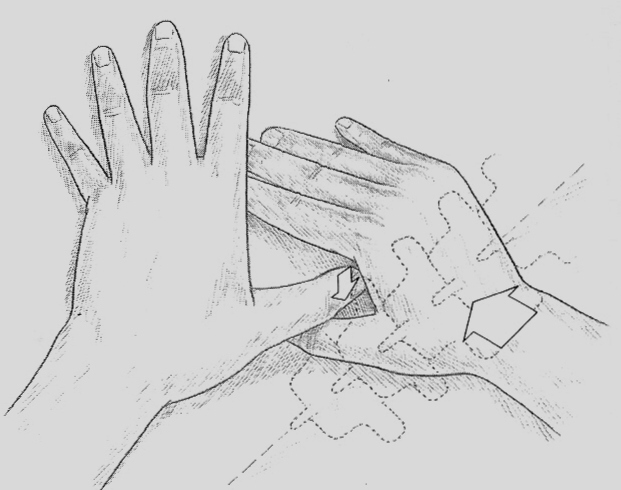
Once located, tender or painful points (lying no more lateral than the tips of the transverse processes) are palpated for their sensitivity to pressure.  Once confirmed as painful, the point is held by firm thumb pressure while, with the soft thenar eminence of the other hand, the tip of the spinal process most adjacent to the pain point is very gently eased towards the pain (ounces of pressure only), so crowding and slackening the tissues being palpated, until pain reduces by at least 75%.  Direct pressure of this sort (lightly applied) towards the pain should lessen the degree of tissue contraction and the sensitivity.

If it does not do so, then the angle of the push on the spinous process towards the painful spot should be varied slightly so that, somewhere within an arc embracing a half circle, an angle of push towards the pain will be found to abolish the pain totally and will lessen the feeling of tension.  This position is held for 20 seconds after which the next point is treated.  A full spinal treatment is possible using this extremely gentle approach which incorporates the same principles as SCS and functional technique, the achievement of ease and pain reduction as the treatment focus.

Induration Technique

Unknown's avatar

Facilitated positional release, FPR (Schiowitz 1990)

Excerpted from:  (Chaitow, Leon.  Muscle Energy Techniques.  2006, Elsevier Limited.)

This variation on the theme of functional and SCS methods involves the positioning of the distressed area into the direction of its greatest freedom of movement, starting from a position of neutral in terms of the overall body position.

To start, the patient’s posture is modified to take the body, or part (neck for example) into a more ‘neutral’ position; maybe some balance between flexion and extension (whatever is appropriate).  This is followed by an application of facilitating force (usually a crowding of the tissues).  No pain monitor is used but rather a palpating/listening hand is applied (as in functional technique) which senses for changes in ease and bind in distressed tissues as the body/part is carefully positioned and repositioned.  The final ‘crowding of the tissues’, to encourage a ‘slackening’ of local tension, is the facilitated aspect of the process, according to its theorists.

This ‘crowding’ might involve compression applied through the long axis of a limb perhaps, or directly downwards through the spine via cranially applied pressure, or some such variation.

The length of time the position of ease is held is usually suggested at just 5 seconds.  It is claimed that altered tissue texture, either surface or deep, can be successfully treated in this way.