Unknown's avatar

Any painful point as a starting point for SCS (McPartland & Zigler 1993)

Excerpted from:  (Chaitow, Leon.  Muscle Energy Techniques.  2006, Elsevier Limited.)

All areas which palpate as tender are responding to, or are associated with, some degree of imbalance, dysfunction, or reflexive activity which may well involve acute or chronic strain.  Unlike Jones’ approach which begins from the viewpoint of identifying the likely position of tender points relating to particular strain positions, it makes just as much sense to work the other way around and to identify where the strain is likely to have occurred in relation to any pain point which has been identified.  We might therefore consider that any painful point found during soft tissue evaluation or palpation, including a search for trigger points, could be treated by positional release, whether we know what strain produced them or not, and whether the problem is acute or chronic.

Experience and logic tell us that the response to positional release o0f a chronically fibrosed area will be less dramatic than from tissues held in simple spasm or hypertonicity.  Nevertheless, even in chronic settings, a degree of release and ease can be produced, allowing for easier access to the deeper fibrosis.

This approach, of being able to treat any painful tissue using positional release, is valid whether the pain is being monitored via feedback from the patient, or by palpation alone.

As previously described, a period of 60-90 seconds is recommended as the time for holding the position of maximum ease.

Unknown's avatar

Functional technique (Bowles 1981, Hoover 1969)

Excerpted from:  (Chaitow, Leon.  Muscle Energy Techniques.  2006, Elsevier Limited.)

Orthopedic functional technique ignores tenderness as its guide to the position of ease and relies instead on reduction in palpated tone in stressed (hypertonic/spasm) tissues as the body (or part) is being positioned or fine-tuned in relation to all available directions of movement in a given region.

A position of combined ease is achieved using what is known as a ‘stacking’ sequence.  One hand palpates the affected tissues (molded to them without invasive pressure).  This is described as the ‘listening’ hand since it assesses changes in the tone as the operator’s other hand guides the patient (or part) through a sequence of positions which are aimed at enhancing ease and reducing bind.

A sequence of evaluations is carried out, each involving different directions of movement (flexion, extension, rotation, side-bending, translation, distraction etc.) with each starting at the point of maximum ease discovered during the previous evaluation, or combined point of ease of a number of previous evaluations.  In this way, one position of ease is ‘stacked’ on to another until all directions of movement have been assessed for ease.  A position of maximum ease will be arrived at which is held (for the appropriate time) until there is a palpable release producing a reduction in pain.

The precise sequence in which the various directions of motion are evaluated is irrelevant, as long as all possibilities are included.

Theoretically (and usually, in practice) the position of maximum ease  (reduced tone) in the distressed tissues should correspond with the position which would have been found were pain being used as the guide as in the previously described approaches.

Unknown's avatar

Goodheart’s approach (Goodheart 1984, Walther 1969)

Excerpted from:  (Chaitow, Leon.  Muscle Energy Techniques.  2006, Elsevier Limited.)

George Goodheart (the developer of applied kinesiology) has developed an almost universally applicable formula which relies more on the individual features displayed by the patient, and less on rigid formula as used in Jones’ approach.

Goodheart suggests that a suitable tender point be sought in the tissues opposite those ‘working’ when the pain or restriction is noted.  If pain or restriction is reported, or is apparent on any given movement, the antagonist muscles to those operating at the time pain is noted will be those that house the tender point(s).  For example, pain (wherever it is felt) which occurs when the neck is being turned to the left will require that a tender point be located in the muscles that turn the head to the right.

In the previous examples of a person locked in forward bending with acute pain and spasm, using Goodheart’s approach, pain and restriction would be experienced when the person straightened up (moved into extension) from their position of enforced flexion.  The action of straightening up would usually cause pain in the back but, irrespective of where the pain is noted, the tender point would be sought (and subsequently treated by being taken to a state of ease) in the muscles opposite those working when the pain was experienced—it would lie in the flexor muscles, probably psoas in this example.

It is important to emphasize that tender point which are going to be used as ‘monitors’ during the positioning phase of this approach are not sought in the muscles where pain is noted but in the muscles opposite those which are actively moving the patient or area, when pain or restriction is noted.

Unknown's avatar

Using Jones’ tender points as monitors (Jones 1981)

Excerpted from:  (Chaitow, Leon.  Muscle Energy Techniques.  2006, Elsevier Limited.)

Over many years of clinical experience Jones compiled lists of specific tender point areas relating to every imaginable strain of most of the joints and muscles of the body.  These are his ‘proven’ (by clinical experience) points.  The tender points are usually found in the tissues which were in a shortened state at the time of the strain, rather than those which were stretched.

Jones and his supporters have also provided strict guidelines for achieving ease in any tender points which are being palpated.  The position of ease usually involves a ‘folding’ or crowding of the tissues in which the tender point lies.

His method involves maintaining pressure on the monitor tender points as a position is achieved in which:

  • There is no additional pain whatever area is symptomatic, and
  • The monitor point pain has reduced by at least 75%.

Jones advocates 90 seconds as the appropriate holding time in the position of ease.

In the example of a person with acute low back who is locked in flexion, the tender point will be located on the anterior surface of the abdomen, in the muscle structures that were short at the time of the strain (when the patient was in flexion), and the position which removes tenderness from this point will, as in previous examples, require flexion with some fine-tuning involving side-bending and/or rotation.

While Jones’ formula is frequently correct, sometimes it is not, and relying solely on Jones ‘menus’ of points and positions, at those times, can fail to produce the desired results.  To overcome this possibility, it is suggested that the operator develop greater palpation skills and other variations on Jones’ original observations to develop a more rounded approach to dealing with strain and pain.

Unknown's avatar

Replication of position of strain

Excerpted from:  (Chaitow, Leon.  Muscle Energy Techniques.  2006, Elsevier Limited.)

This is an element of SCS methodology.

Take the example of someone who is bending to lift a load when an emergency stabilization is required (the person slips or the load shifts) and strain, and perhaps spasm results.  The patient would then be locked into the same position of lumbago-like distortion as described in the example above. If, as SCS suggests, the position of ease equals the position of strain—then the person needs to go back into flexion in slow motion until tenderness vanishes from the monitor/tender point or a sense of ease is perceived in the previously hypertonic shortened tissues.  Adding small ‘fine-tuning’ positioning to the position of ease achieved by flexion usually achieves a situation in which there is a maximum reduction of pain.

Again, the position is held for 60-90 seconds before slowly returning the patient to a neutral position, at which time a partial or complete resolution of hypertonicity, spasm, and pain should be noted.

It will become obvious that the position of strain is nearly an exact duplication of the position of exaggeration of distortion—as in the first example.  These two elements of SCS are of limited clinical value, since patients can rarely describe precisely the way in which their symptoms developed—so ways other than ‘exaggerated distortion’ and ‘replication of position of strain’ are needed , in order to easily be able to identify probable positions of ease.

Unknown's avatar

Exaggeration of distortion

Excerpted from:  (Chaitow, Leon.  Muscle Energy Techniques.  2006, Elsevier Limited.)

This is an element of SCS methodology.

Consider the example of an individual bent forward in psoas spasm/lumbago.  This individual will probably be experiencing considerable discomfort or pain, and will also be presenting with postural distortion—bent into flexion with rotation and side-bending.  Attempts to straighten this individual toward a more physiologically normal posture would be met by increased pain.  Engaging the barrier of resistance would therefore not be an ideal first option.

Moving the area away from the restriction barrier is, however, not usually a problem.  Finding the position of ‘ease’ for someone in this state normally involves painlessly increasing the degree of distortion displayed, placing them (in the case of the example given) into some variation based forward bending, until the pain is found to reduce or resolve.  After 60-90 seconds in this position of ease, a slow return to neutral would be carried out and theoretically—and in common practice—the patient would be somewhat, or completely relieved of pain and spasm.

Unknown's avatar

Positional Release (PR)

Excerpted from:  (Chaitow, Leon.  Muscle Energy Techniques.  2006, Elsevier Limited.)

It is probable that the very first modern positional release technique was discovered by Lawrence Jones, DO, in 1984. He called this technique ‘strain/counterstrain’ (SCS).

Arthur Pauls (1992) accurately termed this counterstrain inspired orthobionomy technique ‘the homeopathy of bodywork’ because positional release techniques subtly allow the body to correct and heal itself.  As such, they are often superior to direct forms of bodywork which forcibly attempt to impose solutions upon dysfunctional structures.

Chaitow’s genius was synthesis, integrating ideas of different thinkers and clinicians, including DOs, DCs, PTs, MDs, and Bodyworkers.

Chaitow described and demonstrated accurate diagnostic and powerful treatment techniques.  In fact, counterstrain diagnostics have been found to be more accurate than standard osteopathic and chiropractic assessments of patients with neck pain (McPartland, Goodridge & Brodeur, 1996).  In this study, the strain/counterstrain method of diagnosis known as ‘provacative palpation’ was found to be superior to three traditional palpation methods:  assessment of segmental motion (ROM range of motion), local tissue texture changes, and elicitation of pain of joint capsule tenderness.

Patients prefer positional release treatments: there are fewer side effects and the methods are easier to learn.  As John Goodridge, DO has suggested, ‘positional release techniques are the future’.

Several different methods exist that involve to positioning of an area of the body, or the whole body, in such a way as to evoke a therapeutically significant physiological response which helps to resolve musculoskeletal dysfunction.  The means whereby these beneficial changes occur seem to involve a combination of the circulatory and neurological changes that take place when a distressed area is placed in its most comfortable, its most ‘easy’, most pain free position.  The developer of the positional release technique known as ‘functional technique’, Harold V. Hoover (1969), termed this position ‘dynamic neutral’.  Charles Bowles (1969) has further discussed dynamic neutral:

Dynamic neutral is the state in which tissues find themselves when the motion of the structure they serve is free, unrestricted and within the range of normal physiological limits… Dynamic neutral is not a static condition… it is a continuing state of normal, living motion, during living activity… it is the state and condition to be restored to a dysfunctional area.”

The terms ‘ease’ and ‘bind’ are frequently used to describe the extremes of restriction and freedom of movement.  The term ‘dynamic neutral’ is considered interchangeable with ‘ease’.

The position of ‘ease’ that Jones discovered was an exaggeration of the position in which spasm was holding his patient.  Since this discovery, that a position which exaggerated a patient’s distortion could provide an opportunity for a release of spasm and hypertonicity, several variations on this basic theme have emerged.

The commonality of all these approaches is that they move the patient or the affected tissues away from any resistance barriers and toward positions of comfort… the position of ‘ease’.  Some approaches require verbal feedback from the patient regarding the degree of tenderness in a ‘tender point’ which is being used as a monitor, and which the operator is palpating while attempting to find a position of ease.  Other ‘functional’ methods or ‘positional release’ approaches involve the operator finding the position of maximum ease by means of palpation alone.

It is important to note that if positional release methods are being applied to chronically fibrosed tissue the result would produce a reduction in hypertonicity but would not result in any reduction of fibrosis.  Pain relief or improved mobility may be only temporary or partial in such cases.

Unknown's avatar

MET Occipitoatlantal (C0-C1) Condylar Glide

Diagnosis

  • Position:  ESrightRleft
  • Motion Restriction:  Forward-bending, left side-bending, and right rotation.

Treatment

Patient is supine on the table.

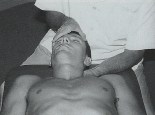
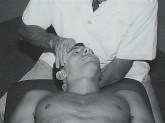
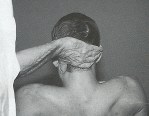
Operator’s left thumb and index finger grasp the posterior arch of the atlas and the occiput lies in the palm of the operator’s left hand.  Operator’s right hand spans the frontal region of the patient’s head.CG2


Operator rolls the head into forward-bending and with the right hand introduces left side-bending and right rotation against the resistance of the atlas CG4held by the operator’s left hand.

A 3-5 second mild isometric contraction of the head into backward-bending, or right side-bending is resisted by the operator’s hands.

After relaxation, the new barriers are engaged and the patient repeats the isometric contractions 3-5 times.

Retest.

Diagnosis

  • Position:  FSleftRright
  • Motion Restriction:  Backward-bending, right side-bending, and left rotation.

Treatment

Patient and operator (hand) positions are the same as above.

Operator introduces backward-bending through rotation, side-bending to the right, and rotation to the left with the right hand. CG8

Patient provides mild isometric contraction in the direction of forward bending or left side-bending against resistance offered by the operator’s right hand and against the atlas stabilized by the operator’s left hand.

After relaxation, the new backward-bending, right side-bending, left rotational barriers are engaged and the patient repeats the isometric contraction 3-5 times.

Retest.

Unknown's avatar

MET Occipitoatlantal (C0-C1)-ext.

Diagnosis

  • Position:  ESrightRleft
  • Motion Restriction:  Forward-bending, left side-bending, right rotation.

Treatment

Patient is supine on the table with the operator sitting or standing at the head.

Operator’s left hand controls the patient’s occiput with the web of the thumb and the index finger along the soft tissues of the suboccipital area.OAext2


The operator’s right hand cups the chin with the index finger in front and the middle finger below the tip of the ramus.  The operator’s right forearm is OAext3placed along the right side of the patient’s head.
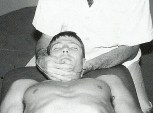


Forward-bending is introduced by rotating the head forward by the operator’s hands around a transverse axis through the external auditory meatus.OAext4


Left side-bending and right rotation are introduced by the operator’s right forearm with slight left-to-right translation of the patient’s head to engage the restrictive barrier. OAext5(Right rotation is not actively introduced)


Patient instruction is to push the head directly posterior toward the table and into the hand offering resistance for 3-5 seconds of a mild isometric contraction. (An eye motion activating force is to look up toward the operator or toward the eyebrows.)

After relaxation, the operator engages the new forward-bending, left side-bending, and right rotational barriers.

Patient repeats the isometric contractions 3-5 times.

Retest.

Unknown's avatar

MET Occipitoatlantal (C0-C1)-flex.

 Diagnosis

  • Position:  FSrightRleft
  • Motion Restriction:  Backward-bending, left side-bending, right rotation.

Treatment

Patient is supine on the table with the operator sitting or standing at the head.

Operator’s left hand controls the patient’s occiput with the web of the thumb and the index finger along the soft tissues at the cervicocranial junction.OAflex2


Operator’s right hand holds the patient’s chin with the index finger in front and the middle finger below the tip of the ramus and with the right forearm in OAflex3contact with the right side of the patients head.


The backward-bending barrier is engaged by the operator’s hands rotating the head posteriorly around a transverse axis through the external auditory meatus.OAflex4


Left side-bending is introduced through the operator’s right forearm by slight left-to-right translation. (Rotation is not actively introduced)OAflex5


The patient is instructed to look down at the feet or pull the chin toward the chest against resistance offered by the operator’s right hand for a 3-5 second light isometric muscle contraction.

After relaxation, the new backward-bending, left side-bending , and right rotational barriers are engaged.

Operator’s muscle contraction is repeated 3-5 times with the operator relocalizing against the resisted barrier after each effort.